Mapping the Productive Uses and Hard Limits of Designing with AI
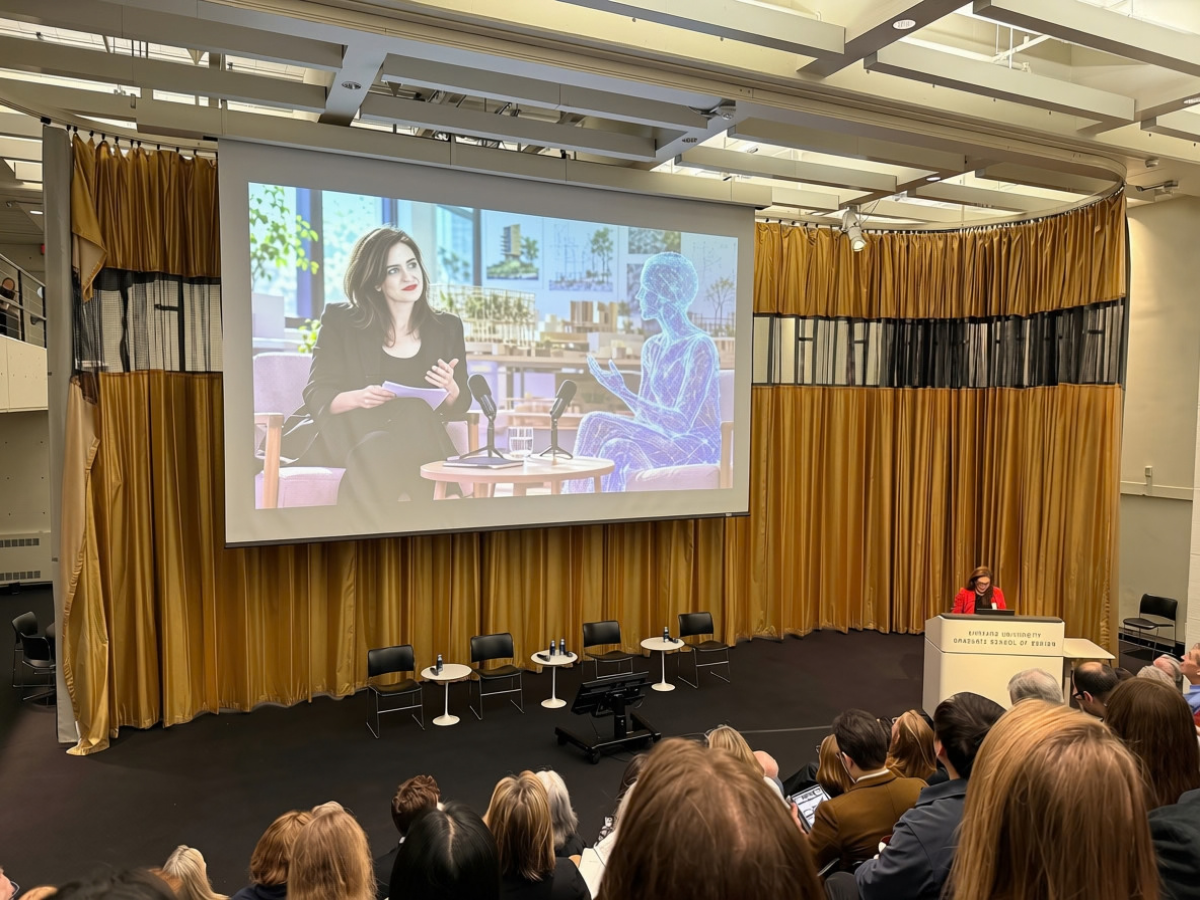
Belinda Tato converses with an AI agent. Photo: Leah Ray.
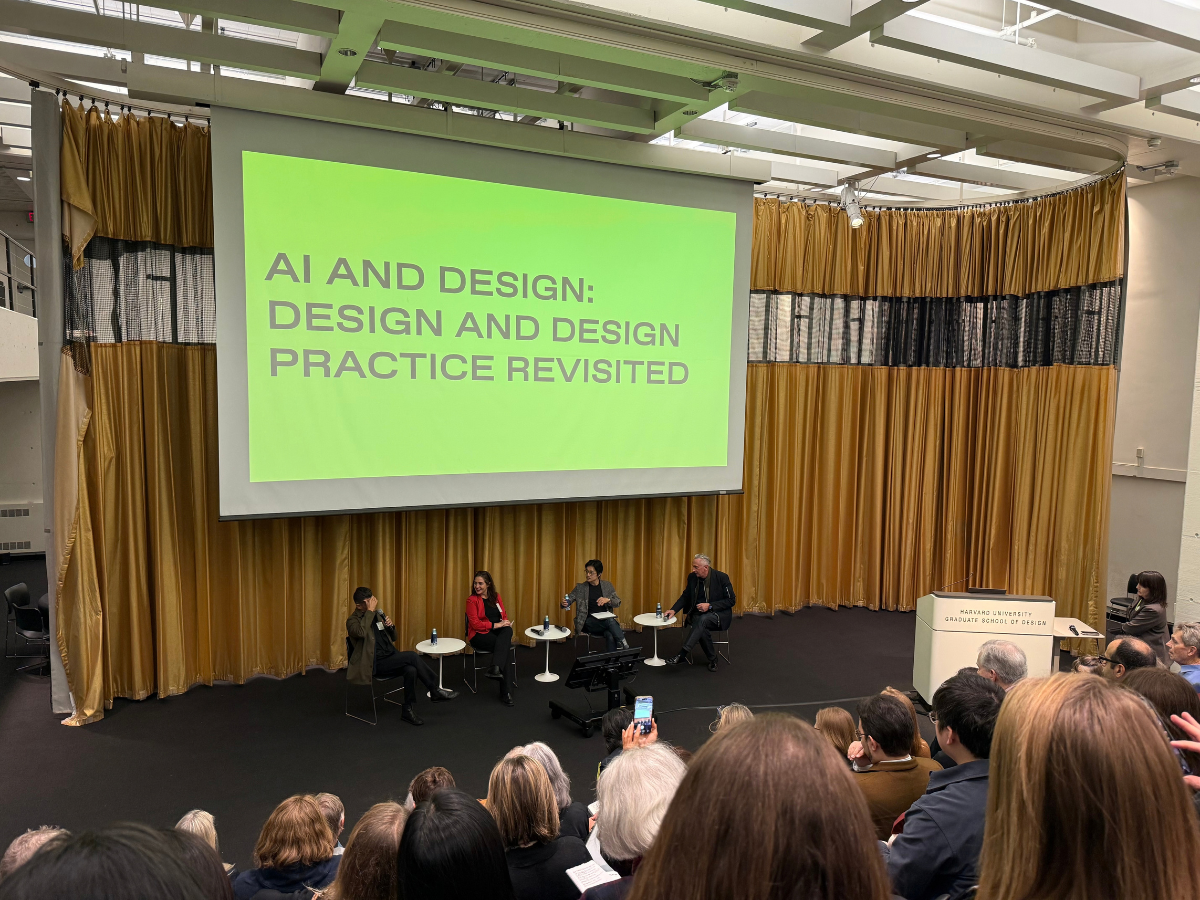
How is AI impacting design and design research now? During “AI and Design: Design and Design Practice Revisited,” a panel that took place September 26 at the Harvard GSD’s biannual reunion, The Comeback, four GSD faculty joked that by the end of the panel, their answers would be outdated. Nonetheless, they offered as current a peek as possible into what’s happening at the school.
The panel covered machine learning in urban research, the theory of computation, AI as a design collaborator, and custom software built with large language models. Across four very different presentations, one conclusion permeated: AI can multiply design options, and designers themselves must decide which options matter.
Charles Waldheim, John E. Irving Professor of Landscape Architecture and director of the GSD’s Office for Urbanization, moderated the session. He noted that every panelist had opened with a disclaimer of expertise. Associate Professor of Architecture John May offered an explanation. Design, he suggested, has lived in an age of perpetual amateurism for some time, and fluency in constant learning now matters more than mastery of any single platform.
Research at the scale of an archive
Waldheim opened with a project from his research group. Ed Ruscha has photographed the major boulevards of Los Angeles for decades with a motorized camera rig, and the Getty now holds thousands of his negatives, many of which no one has ever processed. Stamen, the San Francisco data visualization studio led by Eric Rodenbeck, built a public website, 12 Sunsets, that lets anyone explore the collection.
Drawing on the work of the digital artist Refik Anadol, the Office for Urbanization trained a machine learning model on Ruscha’s images to identify something akin to the typological DNA of a Los Angeles boulevard. The model captures the street's character without reproducing a single photograph. Researchers and students can sort the material by decade, by geography, and by visual element.
“Our goal has been to try to grasp more images than we can view with the human eye.” —Charles Waldheim
The project illustrates a productive division of labor. The model processes an archive too large for any human team to view, and researchers interpret the analysis. Students then receive the results as raw material for original work, free of mimicry or stylistic copying.
Has our intelligence always been artificial?
May, a GSD graduate and a scholar of history and theory as well as an architect and founder of MILLI0NS, an LA-based practice, frames every question in terms of processes. He argued that thought has always happened in partnership with some medium, from cuneiform tablets to computation. In his view, human intelligence has always been artificial.
He then showed how completely AI has inverted architectural representation.
For centuries, a project began with a rough sketch, progressed through plans and sections, and ended with a hired renderer’s finished image. Today a designer can prompt Midjourney for a completed tower in seconds and refine it in Nano Banana. The image now comes first. May joked that the pace of new releases would make his talk obsolete before the audience left the room.
The implications extend well beyond representation.
The automation of manual labor gave rise to unions, the forty-hour week, and a whole politics of work. According to May, the profession has now entered a new phase, the automation of mental labor, and no politics exists for it yet because no one has developed an adequate theory of it. Meanwhile, a wave of managerial software has already begun to reorganize how firms of every size distribute their work.
“As I always tell my students, we work just as hard today as anyone who did hand drawing. But that labor time gets distributed in very different ways.” —John May
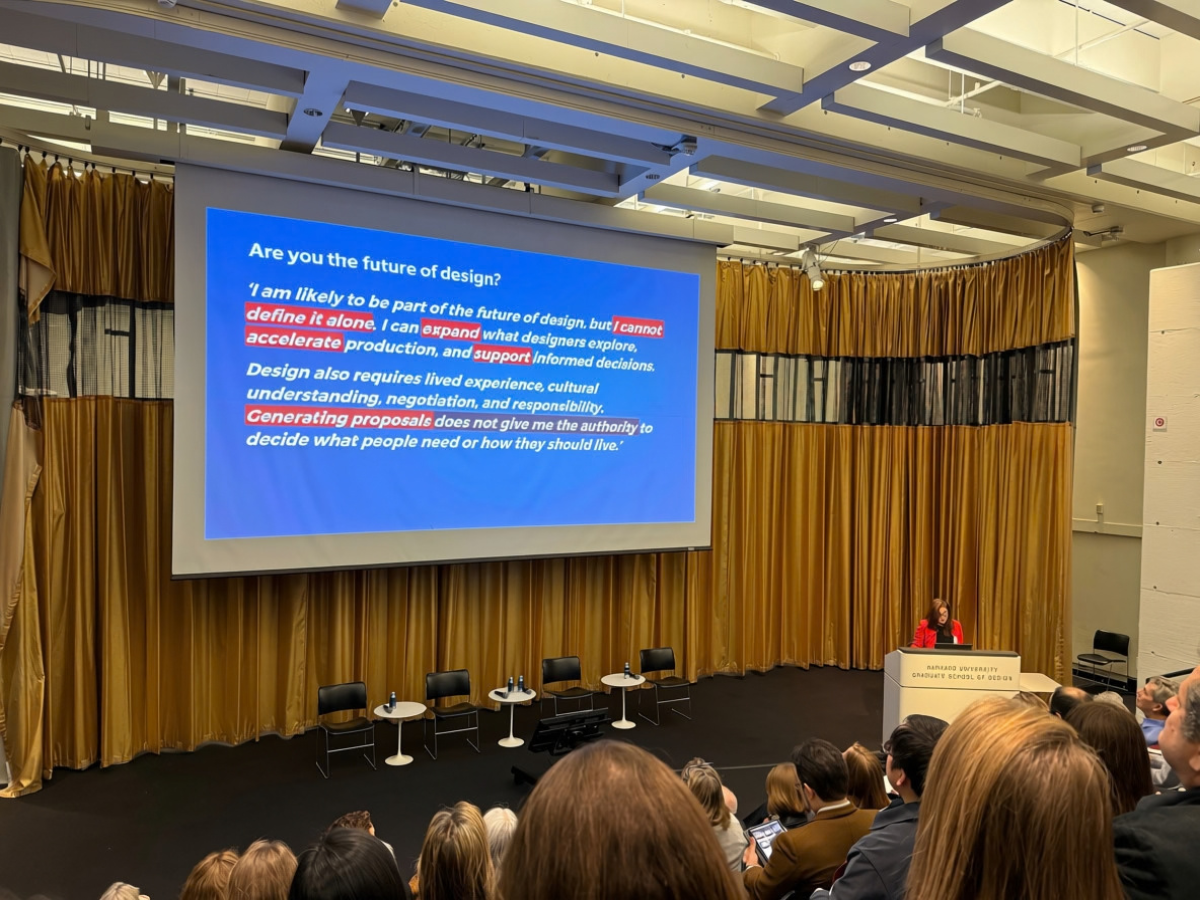
Belinda Tato reveals AI’s responses to her questions about its role in design. Photo: Leah Ray.
Design is deciding
Belinda Tato, cofounder of the Madrid practice Ecosistema Urbano, structured her talk as an interview with AI. Asked whether it could design, the system replied that it could generate concepts and alternatives, and that generating a proposal gave it no authority to decide what people need or how they should live.
“Design is not simply the production of options. Design is the process of deciding, deciding which options matter for whom and why.” —Belinda Tato
Tato pressed on the costs. AI feels weightless because the industry calls it the cloud, she observed, yet every query draws on data centers, electricity, water, and hardware. Prompts for a secretary and a boss returned predictable stereotypes. Asked about designing for heat, the system acknowledged that it can propose shade and has never felt heat. Architecture acts on bodies and lives, Tato argued, and that work demands human presence, interpretation, and judgment.
She also asked who captures the time that AI saves. The answer could be a four-day week, more time for research and family, or four more deadlines. Tato framed that choice as a social and political decision for the profession to make.
Her competition work demonstrated the collaboration in practice. Her team entered a shortlisted international competition with a clear vision and no clear route to render it. The first AI output resembled an old-fashioned watercolor, and subsequent rounds swung out of control. Over many iterations, the team learned to domesticate the tool, a process Tato described as building a bond between two collaborators who gradually came to understand and support each other.
Her account suggests a model for the profession. The partnership between people and AI matures the way any studio team matures: through time, iteration, and a growing capacity to understand and support each other.
Who builds the tools?
Min Yeo, a design critic in landscape architecture who teaches in the core studio and representation sequences, began with Isamu Noguchi. Noguchi treated form as a device for controlling shade, water, and movement, and Yeo teaches that every landform carries ecological and programmatic consequences. Yeo built a seminar around that premise called Ecological Do-Nothing Landforms, a nod to Charles and Ray Eames’s Solar Do-Nothing Machine.
The seminar depended on Grasshopper plugins that generous enthusiasts had shared online, and those plugins kept breaking. A developer’s weekend project would stop working the moment Rhino updated. By the second run of the course, Yeo found the pedagogy bending around the limits of the available software, and so Yeo built a new tool.
The result, Landform, is an open-source, mesh-based terrain plugin for Grasshopper. Users sculpt a surface and watch drainage, slope, solar exposure, visibility, and optimal paths update in real time. Yeo describes the goal as a continuous feedback loop between design intent and environmental performance. The workflow now anchors the core representation and studio sequences, and in just three days of preterm this fall, students produced landforms that Yeo called beautiful, strange, and highly unrealistic, yet genuinely informative.
What is the Harvard AI Sandbox?
To write Landform, Yeo worked with large language models, in what many now call vibe coding, inside the Harvard AI Sandbox. Harvard University Information Technology built the Sandbox as a secure, walled-off environment where faculty, staff, and students can work with leading models from OpenAI, Anthropic, Google, and Meta through a single interface. Nothing a user enters trains a vendor’s model, and Harvard has approved the platform for medium-risk confidential data. For GSD faculty and students, the Sandbox offers a protected place to experiment, to fail, and to build.
Yeo also drew on Andrew Witt’s concept of grayboxing, which asks how much of the underlying mathematics and code a designer needs to see, and how much can stay hidden yet controllable enough to support confident action. Yeo now tests Landform in the classroom and in professional settings specifically to locate its walls. The approach typifies current research at the school. Faculty push these tools until they break, study the failure, and share what they learn.
“It’s about who gets to build the tools that shape design education.” —Min Yeo
The walls and the limits
Every speaker addressed limits. In response to an audience question about construction, May noted that material systems, entrenched labor practices, and job sites resist the speed of software, and that the GSD now places even greater emphasis on material systems as a result. Accreditors will still check the door swings. A practicing landscape architect in the audience added that grading still defeats most software, because the physical world remains stubbornly uneven.
Image making sits at the opposite extreme. Waldheim reported that a visiting faculty member who runs one of the world’s leading architectural visualization studios told him last spring that the business had all but disappeared. Clients now arrive at design firms with their own AI images in hand. Waldheim’s wife, a graphic designer, finds that those images can terrify, open a conversation, and reveal which clients will make good partners, all at once.
Admissions surfaced the limits with some comedy. May reported that reviewers kept encountering the same hallucinated claim, that the twenty-first century is a machine for producing loneliness, in eleven essays by his count. Some history and theory faculty have returned to handwritten blue books. Studio faculty have moved in the other direction and simply ask students to disclose their workflows.
If design is no longer about production, then what?
Tato put the question most directly. When anyone can generate an image, images lose their value, and the value moves to the thinking behind them. Critical thinking becomes the core skill. If a client walks in with a finished AI rendering, the designer’s job becomes explaining why that image might not make a good project.
May framed the shift as a matter of judgment. Orthography required designers to produce the minimum data needed to plot a curve. Computation presents the opposite problem: far too much data, always. When Grasshopper can produce a thousand iterations in an instant, the scarce skill becomes aesthetic judgment, the ability to choose among options and stake out a position. Those choices, May noted, carry ideological weight.
The panel also described a subtle shift in the classroom. May calls it reversal pedagogy. He no longer assumes he understands how a student produced a final output, so he asks with genuine curiosity and learns from the answers. Knowledge now moves from the bottom up, and a studio of ten or eleven students, each experimenting differently, functions as a small, crowdsourced research lab.
A natural evolution, and a defining moment
The panel conversation was notably calm at a cultural moment when AI often elicits fear (as later alumni commentary made clear). Yeo pointed out that only months ago critics worried that AI could not draw fingers, and no one raises that problem anymore. Architects felt a similar loss when CAD eliminated the slight overrun of a hand-drawn line at a corner. May reminded the audience that CAD itself began in academia, with Ivan Sutherland’s Sketchpad at MIT, and Waldheim observed that this disruption appears to be reaching the academy before the profession has had time to professionalize it.
Taken together, the presentations framed AI as the latest chapter in a long evolution, from orthographic drawing to CAD to parametric scripting. Economic history supports that reading.
In a September 2026 discussion paper, “The AI Economy: Interconnected Forces, Feedback Loops, and Speeds of Change,” the McKinsey Global Institute traces how each general-purpose technology has reached its peak effect on economic growth faster than the one before it. Steam power took about a century from commercialization to its peak contribution. Electricity took about forty years, and computers and the internet took about twenty-five. The authors caution that no one can yet say whether AI will compress that timeline further. If it does, businesses, workers, and governments will have less time to adjust.
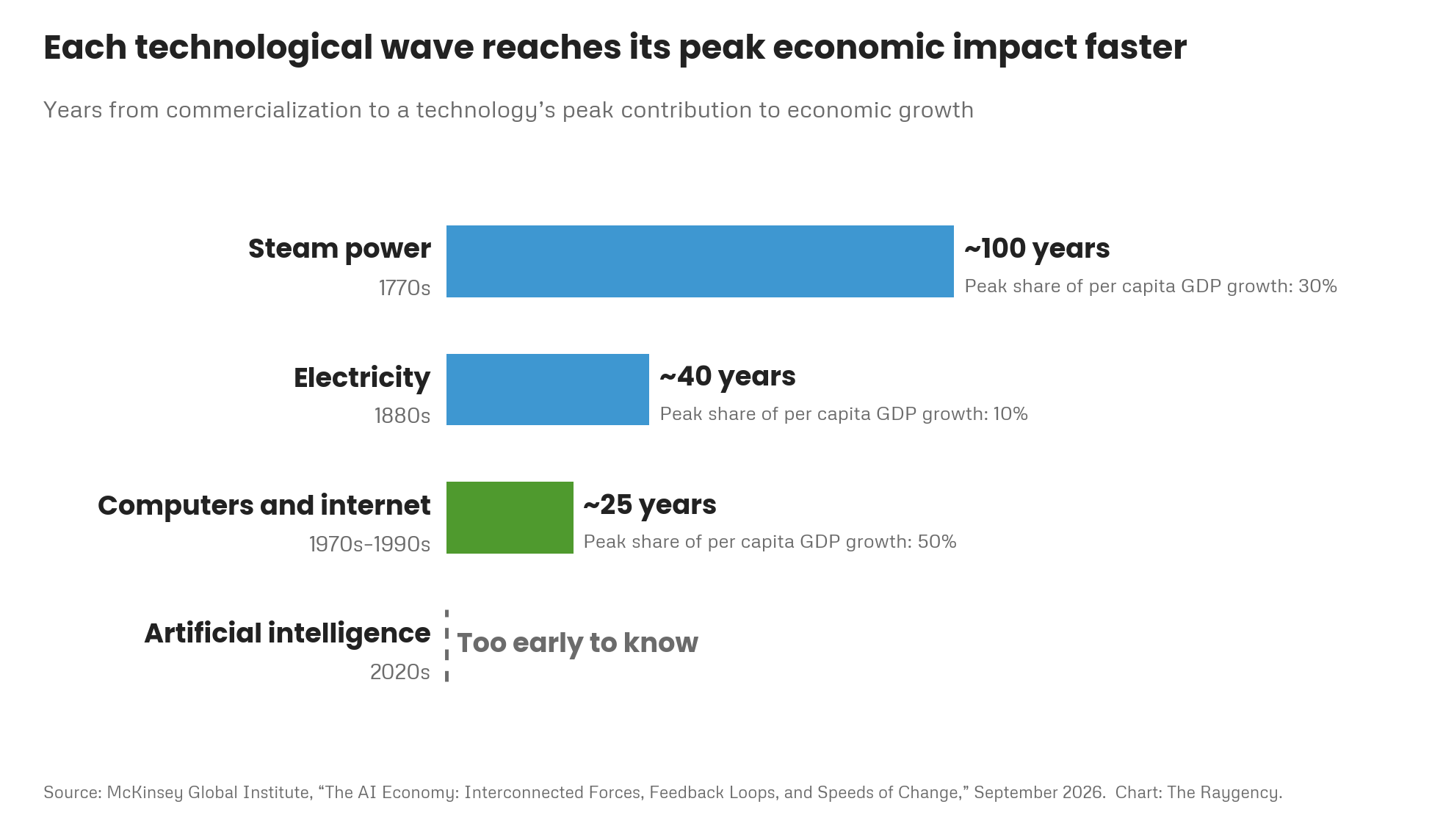
Each general-purpose technology has reached its peak economic impact faster than the last. Data: McKinsey Global Institute, September 2026. Chart: The Raygency.
The same research clarifies what sets this chapter apart.
1. The first difference is pace. By one measure the report cites, the complexity of tasks AI can reliably complete has doubled roughly every four months since 2023, while data centers, power grids, and organizations change far more slowly. May’s joke about his talk expiring before the audience left the room touched upon a real acceleration.
2. The second difference is reach. Earlier waves of automation mostly affected physical labor, and AI now reshapes knowledge work, the territory May described as mental automation. That combination makes the present a defining moment for the discipline and for everyone who designs, teaches, or communicates about design.
The research also echoes the panel’s emphasis on redesign. Electricity delivered its largest productivity gains only after manufacturers rebuilt their factories around the electric motor. AI appears to follow the same pattern. In a McKinsey survey conducted in mid-2026, nearly nine in ten organizations reported regular use of AI, yet outside a small group of high performers, only about a quarter had redesigned their workflows around it. The authors also suggest that human strengths such as judgment and curiosity may grow more valuable as AI advances, a conclusion every speaker at the Comeback would recognize.
Tato closed her talk with a hope for partnership, with people and AI each learning over time to understand and support the other. That partnership will demand judgment, care, and a willingness to take responsibility for what designers choose to make.
Yeo’s question remains the most consequential one the panel raised. If design is no longer primarily about production, the discipline’s future depends on who shapes the tools that educate the next generation, and on whether designers, educators, and communicators choose to help build them.