Five Key Takeaways from the AIA Conference on Architecture 2026
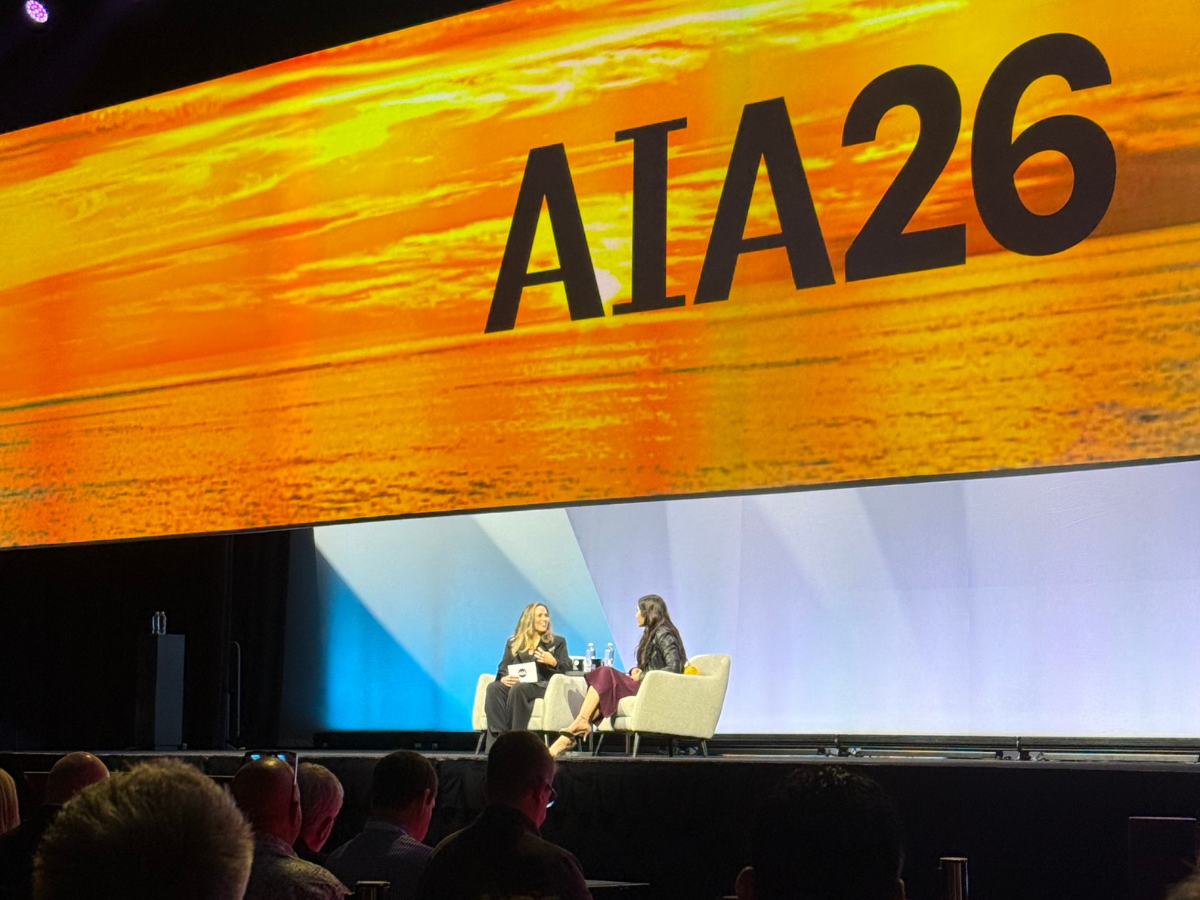
AIA President-Elect Yiselle Santos Rivera in conversation with Padma Lakshmi at the AIA Conference on Architecture
The annual AIA Conference on Architecture is enormous in scale, scope, and breadth of ideas debated. It's entirely possible to attend from the first session to the last yet leave haunted by niggling FOMO.
I approach the conference looking for three things: what's innovative, what's inspirational, and what's actionable — to my business strategy, and importantly, to my clients'.
This year in San Diego, the silent question conference participants addressed was: in a world of exponential change driven by AI, climate change, and societal shifts, how can architects contribute to adaptation, to regeneration, and to abundance? From Padma Lakshmi's opening keynote to Sameh Wahba's closing, with myriad pointed conversations about AI in between, the same answer kept surfacing in different ways: work with nature and work together.
Here are five takeaways that resonate with me.
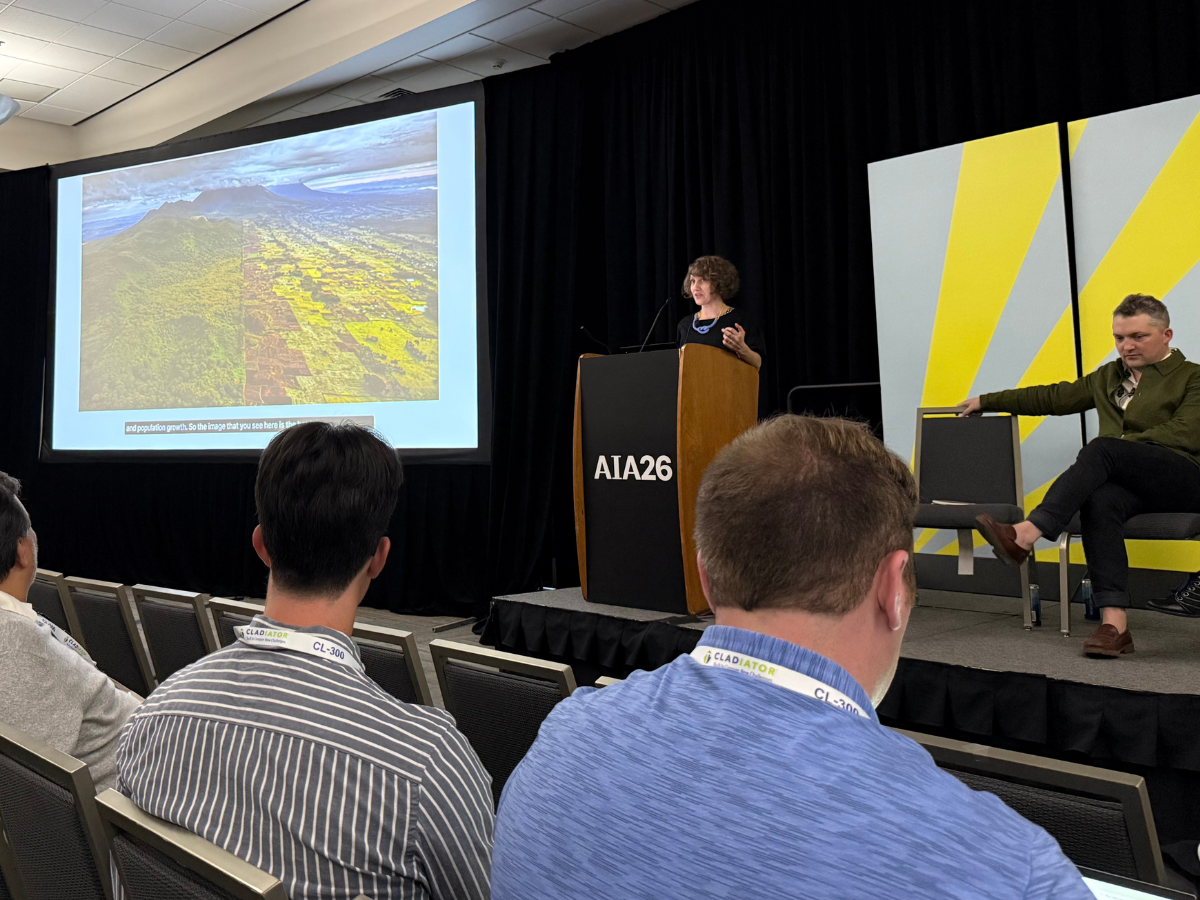
Emily Goldenberg and Chris Hardy of MASS Design Group present the firm’s work in the context of abundance.
1. Sustainability Resilience Abundance
For most of the last decade, architectural climate vocabulary has been one of less — less carbon, less waste, less consumption. Restraint was seen as the highest virtue.
AIA2026 offered a different word: abundance. Not in terms of things, but outcomes: more life, more shade, more health, more access, more of what a place gives back to its users. It's an important shift, from designing to do less harm to designing to do more good.
In "Seeking Abundance: Design, Ecology and a Flourishing Planet," hosted by MASS (Model of Architecture Serving Society) senior principal Katie Swenson with design directors Emily Goldenberg and Chris Hardy, the speakers did something I wish more sessions would: they inspired change through storytelling.
Citing Kate Raworth's doughnut economics, MASS defined abundance as ecological balance: systems healthy enough to regenerate and sustain life over time. Note that "seeking" is an active verb in this definition, framing abundance as motion, a refusal to treat present conditions as fixed.
Speakers posited: if architecture inevitably leaves a footprint, can it also restore, conserve, and repair? Their answer starts by inverting design tradition: begin with the landscape, then nestle the architecture into it.
At the Rwanda Institute for Conservation Agriculture, that meant mapping soils, slopes, and hydrology to determine the best use of every acre, propagating roughly a million native plants from seeds and cuttings collected on-site, and treating performance as soil health, biodiversity, and water, rather than simply assessing energy. The measurable impacts make the ethics clear: 98 percent of the labor came from within 100 miles of the site, 96 percent of materials from within Rwanda, most of the $75 million budget stayed in the local economy, and the buildings carry about half the carbon of the region's conventional concrete-and-steel norm.
When the original contractor went insolvent mid-build, MASS hired all 2,000 workers directly — turning a crisis into traceable supply chains and shared ownership.
At the Ellen DeGeneres Campus of the Dian Fossey Gorilla Fund, a degraded potato field has become a living laboratory where more than 250,000 plants from 200-plus native species flourish, and on-site bird diversity has increased to 52 species. To keep labor and procurement in-house, MASS founded its own construction company. It certified more than 200 workers, a quarter of them women, over the years that coincided with the mountain gorilla moving from critically endangered to endangered.
A fair question from the conference audience was whether any of this applies locally. MASS brought two US projects to argue it does: the Wind River Tribal Buffalo Initiative Center in Wyoming, where buffalo behavior drives the building's form, and the New Lots branch of the Brooklyn Public Library, built beside a paved-over African burial ground and designed as a place of gathering and repair.
In MASS’s approach, regeneration begins at the onset through a set of questions about provenance, labor, and afterlife, and the design is better because they were asked.
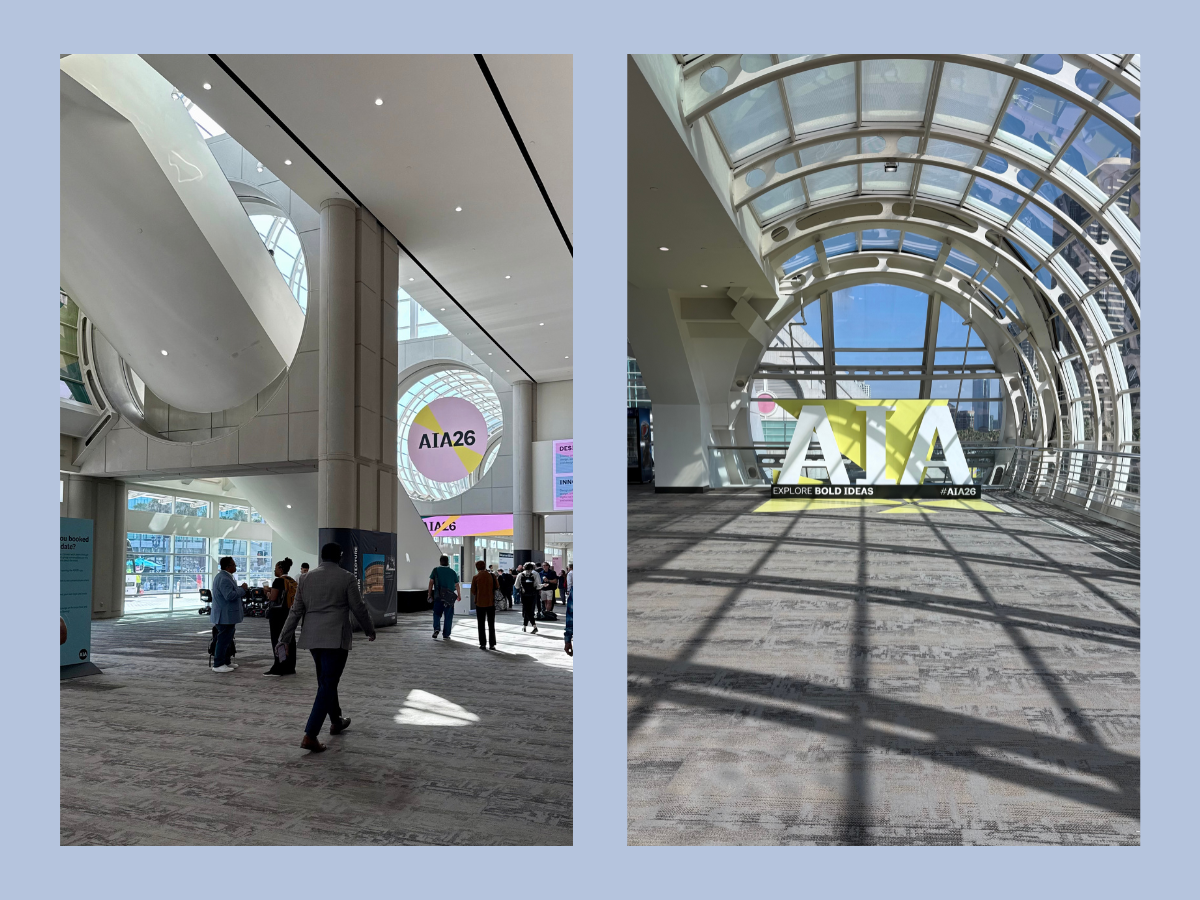
The geometry and natural light of the San Diego Convention Center proved a key point: working with nature, and working together, works better.
2. Lead with nature. It sustains, regenerates, and connects us.
A few years ago, conversations about "nature-based solutions" at the AIA Conference largely took place in technical panels on biophilia. This year, they permeated conference conversations ranging from living systems as infrastructure to watersheds as design partners.
What struck me was the range of people arriving at it independently. A food expert, a regenerative practice, a materials technologist, and a World Bank economist were not coordinating their talking points. Yet, all of them landed in roughly the same place: the most resilient things we can build with are the things we already have. When an idea reappears across that many disciplines, it has stopped being marginal and become an industry driver.
During the opening keynote, food expert Padma Lakshmi observed that building with living systems isn't only more sustainable and more abundant; it's also how we connect.
During her conversation with 2027 AIA president-elect Yiselle Santos Rivera, she focused on cultivating human connection — the kind food makes, and the kind a room makes. She described cooking as something you do for the single moment when someone first tastes a meal, and Santos Rivera likened that experience architecturally to the first time someone walks through a door into a newly designed space.
Lakshmi homed in on the body, the senses, and the critical importance of feeling cared for. Cooks understand this instinctively, and Lakshmi approaches it through nature first, considering where things grow and who grows them. She spoke of harnessing the natural flow of things, even in difficult times, noting that civilizations have always learned to forage in extreme ecological circumstances.
The opening keynote was a generous reminder that architecture is, ultimately, about being human and rooted in a place.
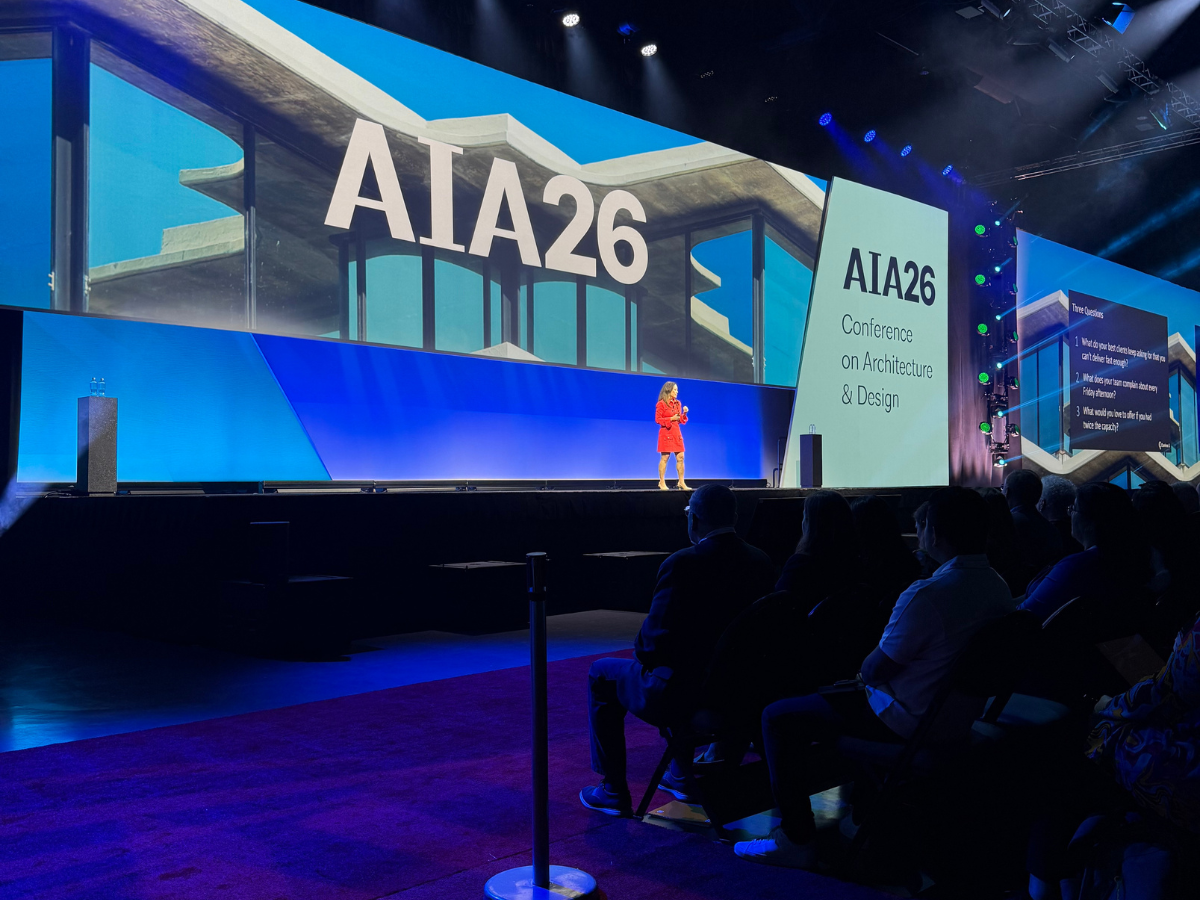
Charlene Li challenged architects to see AI as a strategy for achieving business goals.
3. AI problems are leadership problems
Charlene Li gave the talk that many firms needed, but few wanted to hear. Her thesis was blunt, borrowing a line from Stephanie Holmes:
Most firms aren't failing at AI.
They're failing at leadership.
Li said that AI is often treated as a technology handed off to whoever is most comfortable with software, and the result is lackluster. Why? Because AI is a strategy question, not an IT one. When leaders abdicate it, the best people leave, shadow tools multiply, and vendors end up setting the agenda.
Her prescription was refreshingly plain. You need a business strategy, not an AI strategy. With a business plan in hand, you can craft an AI roadmap that serves it. Li further noted that your strategy should be "written in ink," and your roadmap "in pencil," because AI evolves hourly. She recommends an adaptive 18-month roadmap, revisited every quarter.
The term adaptive emerged as a key theme for the conference. Even your plan should be designed to change.
She was equally clear about the point of adopting AI in the first place. It isn't about productivity or optimization. It's about advancing your business and your clients' — using it to build judgment, bring clients into the design conversation earlier, and hand people back the parts of the work they came for.
Her question, the one I keep returning to: what can you do with AI to connect with joy? For architects, she sees AI as enabling practitioners to spend more time on creative direction, curation, or translation, and less on production.
In closing, Li advised: use AI responsibly. Your values should forge a metaphorical fence, which your team should explore right up to its ethical edge. Rather than piloting every idea your team has, start with what you know, do fewer things, and do them better.
4. The most ethical AI is the one you don't run alone
If Li set the AI leadership vision, the “Supercharging Sustainability with AI & Materials that Matter” workshop made it actionable — and asked a question most AI sessions skip. Rather than "how do we use AI," it asked: "what does AI itself cost the planet, and how do we use it without making the problem worse?"
Andre Baros, an architect from Acelab, put real numbers behind the worry. A careless prompt to a large language model can burn more energy and water than a material selection saves. Asking a frontier model to choose between two nearly identical products can cost more than you'd ever recover from the better choice.
Some firms have already done that math; the key is sharing it.
His approach to using AI to assess material selection is both strategic and collective. Use smaller, derivative models that run for pennies, sometimes on your own laptop. Run a query once and share the result — across your firm and then across the industry — the way a single organization can audit thousands of environmental product declarations once, so everyone else can reference clean data. Sustainability, he said, is not a heroic exercise. It's a collective one.
The part I appreciated most was the human layer. The work of all this tooling — Acelab's connected materials database, the tagging, the shared libraries — is to give designers time back, so a smaller firm doing public projects can find vetted, sustainable products in seconds rather than hours.
The end goal is noble and necessary: sustainable material choices should be the easy norm, not a time-consuming, hard-to-determine exception.
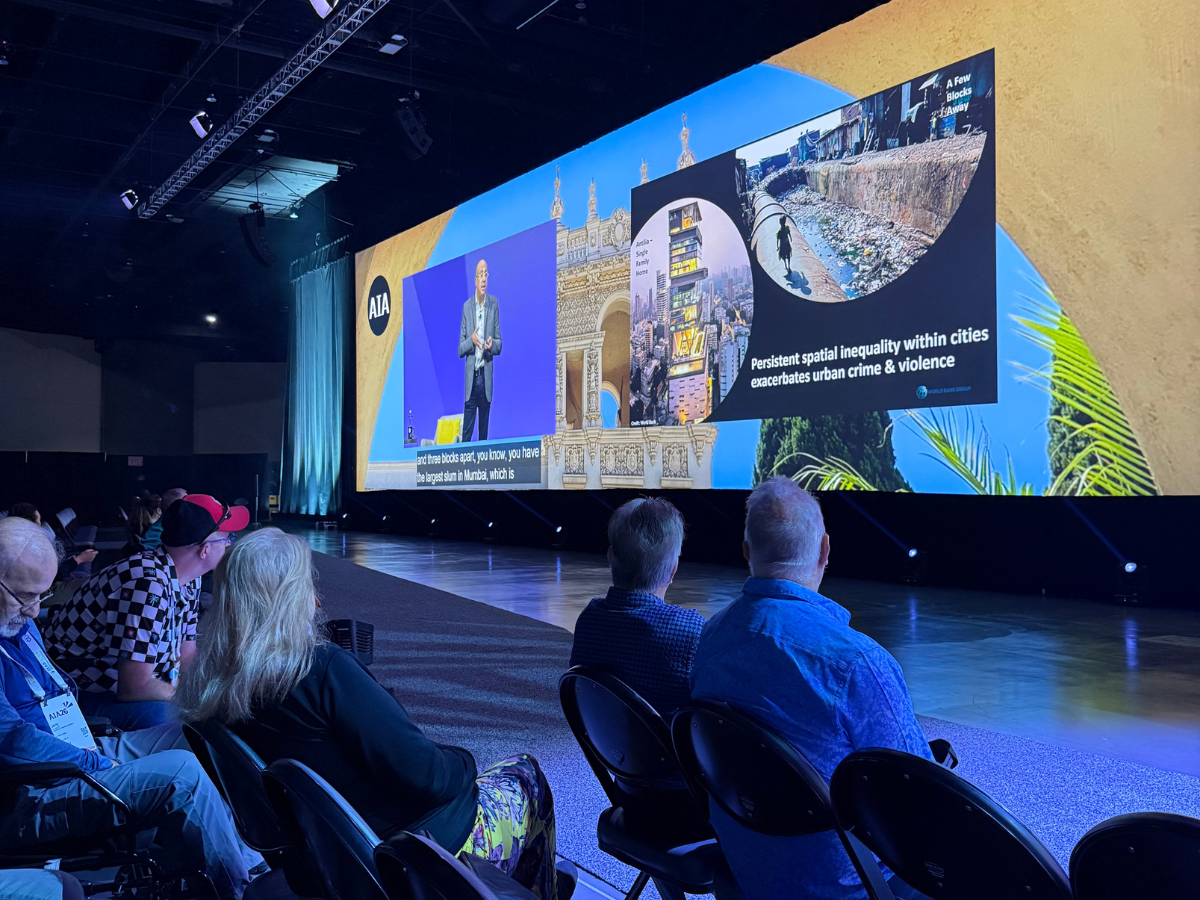
World Bank’s Sameh Wahba, an architect and urban planner, argues that architects can spur systemic urban change.
5. Architects are catalysts at the scale of systems
Sameh Wahba closed the conference Saturday morning with a 10,000-foot perspective. An architect by training who became an urban planner and development economist, Wabha oversees a roughly $10 billion portfolio at the World Bank and has worked across more than 100 countries.
His message: when they work, cities are an escalator out of poverty — and most of the urban world that will exist by mid-century hasn't been built yet, overwhelmingly in the global south.
To inspire change, he offered examples of innovative programs that the World Bank is investing in now:
In Freetown, the bank pays residents to plant and monitor trees, which mitigates both erosion and flooding while adding income and tree canopy at once.
In Dar es Salaam, protecting the city's flood-prone heart unlocks new development whose rising value helps pay for the protection itself — the "triple dividend" of avoided losses, jobs, and environmental benefits.
In Bangladesh, a school is also a cyclone shelter, raised on piloti, with room below for the animals and families that bring them when they flee.
Wahba emphasized that architects are most needed in the early stages, when a mayor's idea becomes a fundable project. He noted, poignantly, that designers influence only a small fraction of the built environment (approximately seven percent), and the other ninety-plus percent is the real frontier.
Abundance, in his framing, is inseparable from equity.
So what does this mean for us?
The profession has a more hopeful, more human, and more accurate story than the one it usually tells. The old script — efficiency, square footage, the heroic object building — is being replaced by something better: design that connects people, regenerates places, uses new tools responsibly, and creates abundance instead of merely limiting harm.
That's a far more compelling design story, and the firms that learn to tell it clearly won't just tell sharper stories. They'll design the work that inspires them.